Wednesday, September 14, 2022

Skip condors

Actually American black vultures, Coragyps atratus.


Sunday, September 11, 2022

Where we go when we sleep

She woke up crying, which woke me up in turn.

"What's the matter, love?"

"I had a bad dream. A silly bad dream, but still..."

In the dream, she'd been the passenger in a car and had spotted a pair of bobcats. Her companion (not me) had stopped only briefly and begrudgingly—"You got a picture, what are you upset about?"—and then refused to stop at all when two kittens appeared. Her sobbing in the dream spilled over into the real world, and there we were.

Relieved that the content hadn't been truly nightmarish, I proceeded to tell her of my own dream: we'd been driving together, away down South somewhere—rural Georgia, perhaps—and were just coming into a town when Fiona (our white Subaru) starting thumping, a tyre having obviously gone flat. I turned off the two-lane highway onto a short gravel drive leading to what appeared to be an open-air antiques store. Stopping by a glass-fronted bookcase, I began perusing a once-magnificent volume—marbled endpapers, sadly deteriorating leather cover—from around the turn of the last century. The author, an eccentric Victorian hunter, related his experience with, and decided opinions on, various cartridges, ranging from a (non-existent) .20-calibre revolver round to his favourite rifle ammunition—I believe it was .500 Nitro Express—for Tyrannosaurus rex.

She laughed at the thought of this mustachioed gentleman in khakis and pith helmet facing down a tyrannosaur with a double rifle—and then again when she realised that grammatically she had just assigned the double rifle to the tyrannosaur, who manifestly did not need it—and her bobcat disappointment dissipated.

[Thank you, Internet. Here's a nice (actually, "best") side-by-side double rifle by London gunmaker E.J. Churchill; this one is chambered in .470 Nitro Express, but it gives the general idea.]


"Completely unreasonable," I observed.

"I know, right? But you would have stopped for as many pictures as I wanted—I know you would."

"Of course, blossom. But actually, I was referring to you."

"Me? What did I do?!"

"You were pretty impatient with my reading that book."

"Why would I mind that?"

"Well, I think you wanted me to deal with the tyre."

Friday, September 9, 2022

Edgar Allan Pоe: a pilgrimage in three parts

Our most recent trip, to Philadelphia and then Baltimore in late August, centered on two writers whom Jessica and I admire: the first being Aaron Weiss, lyricist and lead vocalist for the band mewithoutYou. We saw them at Summit in Denver back in January on their twice-delayed Brother, Sister anniversary tour, and were determined to attend the final concert of their farewell tour, held at the Fillmore Philadelphia. And since we would be in Philly and Baltimore, why not visit another poet in Edgar Allan Pоe? 

I will attempt here neither a full biography nor a literary appreciation of Poe—having, after two and a half years of caution and good luck, finally contracted COVID-19 on our trip, I haven't the energy to do justice to either. Instead, I'll offer thoughts on the specific locations we visited along the way.

* * *

Poe, an affectionate aunt, and a fair cousin in Baltimore 

Although he was born in Boston, Poe had family roots in Baltimore, considered it his hometown, and sometimes (unreliable narrator that he was) claimed it as his place of birth. His grandfather, David Poe, Sr., had emigrated to Baltimore from Co. Cavan, Ireland, just prior to the American Revolution; David served both as a major in the Continental Army and as an assistant quartermaster for the City of Baltimore. In the latter role, he was occasionally known to pay for uniforms and other materiel out of his own pocket; he became a close personal friend of the Marquis de Lafayette, and was  accorded the honorary title of "General" as one of Baltimore's foremost patriots.

Edgar Allan Pоe himself first came to Charm City in the midst of his own (checkered) military career: having dropped out of the University of Virginia, he enlisted in the U.S. Army in 1827 under a pseudonym. Well-educated, personable, and competent, "Edgar A. Perry" rose from private soldier to sergeant major in just two years; Poe then revealed his real name to his commanding officer and announced his intention to end his enlistment early, for the purpose of enrolling at the U.S. Military Academy. After some negotiation, he was able to buy his way out by hiring another man to complete his term of service. Upon securing his release from the Army in 1829, Poe lodged with a succession of relatives in Baltimore before matriculating at West Point in 1830. Within a year, however, Poe had given up on soldiering altogether in favour of a literary career, and contrived to have himself thrown out of the Academy, returning to Baltimore in 1831.

Now, however, Edgar had found a permanent home with a core family. Upon his return, he stayed with his widowed aunt, Maria Poe Clemm. Maria—pronounced with a long "i", as in "Mariah", and known within the family as "Muddy"—lived in a rented house in Mechanics Row on Wilks Street (later Eastern Avenue) in Fells Point. Also present were Muddy's mother (Edgar's grandmother, and widow of David Poe, Sr.), Elizabeth Cairnes Poe; Muddy's daughter (Edgar's cousin), Virginia Eliza Clemm; possibly Virginia's brother Henry Clemm; and Edgar's brother, also named Henry. Henry Poe died in 1831, a few months after his brother's arrival.

In 1832, with a cholera epidemic raging in Fells Point, Muddy and her extended family moved to a house on Amity Street, in what was then the countryside. (The household may or may not have included Henry Clemm; Virginia's brother disappears from the historical record sometime in the early 1830s, with some speculation that he may have been lost at sea.) Edgar lived here until, in 1835, he took a job with the Southern Literary Messenger in Richmond. About that same time, Elizabeth Cairnes Poe passed away at the age of 79. With the loss of Elizabeth's pension (awarded for David Poe, Sr.'s services in the Revolution), Muddy found herself unable to maintain the house on Amity Street. Edgar returned to Baltimore long enough to obtain a marriage license for himself and Virginia (family history holds that they married in a private ceremony in Baltimore) and then moved Virginia and Muddy to Richmond (where a documented wedding ceremony was held in 1836).

(It should be noted, in deference to modern sensibilities, that neither the disparity in the ages of the bride and groom—Virginia was 13 and Edgar 26 in 1835—nor their standing as cousins would have been prohibitive at the time, and the marriage had Muddy's blessing.)

The country house at 3 Amity Street (later 203) was eventually overtaken by the expanding city, and in the 1930s was saved from the wrecking ball by the Edgar Allan Pоe Society of Baltimore. The only remaining Poe residence in Charm City, it now operates as the Edgar Allan Pоe House & Museum. We saw no ravens here—football team notwithstanding, they can be found no closer to Baltimore than the mountains of western Maryland—but did spot a female Cooper's hawk making her morning rounds while we waited for the house to open.


* * *

Poe and his family in Philadelphia 

After several years at the Southern Literary Messenger, Poe moved from Richmond to New York in 1837 and then Philadelphia in 1838, bringing Virginia and Muddy with him. His time in the City of Brotherly Love was productive; during the period from 1838 to 1844 he edited first Burton's Gentleman's Magazine and then Graham's Magazine, and published his only novel, as well as several of his best-known short stories and poems. From 1843 to 1844, the family resided at this house at 532 7th Street in the Spring Garden neighbourhood, now managed by the National Park Service as the Edgar Allan Pоe National Historic Site


With its low ceilings, brick floors, and brick and stone walls hinting at the immurement of "The Cask of Amontillado"—not to mention its enormously long-legged spiders—the basement of the house in Spring Garden is bound to appeal to fans of the macabre. But the macabre is only a part of Poe's repertoire, and even the basement offers a garden view; Virginia tended flowers here.


What struck me about both the Baltimore and Philadelphia houses, and what attracted Jessa's camera, was the ordinary domesticity, the very human scale of these middle-class nineteenth-century homes. (Particularly the lath-and-plaster construction, so like the kitchen Jessa is currently renovating.)


* * *

Poe and his family at rest

Virginia Eliza Clemm Poe suffered from consumption (tuberculosis) by 1842—the National Park Service has identified her bedroom in the Spring Garden house based on evidence of a stove in one of the upstairs rooms—and she passed away in 1847, a year after the Poe/Clemm family moved from Philadelphia to New York. Edgar grieved all through her illness, and again when she died. The loss of a beautiful and beloved woman was already a theme in his work ("To One in Paradise", "Lenore", "The Raven", to cite just a few examples)—small wonder for a writer orphaned at the age of two, who then lost his foster mother at twenty—but culminated after Virginia's death in his final poem, "Annabel Lee".

On 3 October 1849, while on his way from Richmond to New York—and a week after his departure from Richmond—the normally well-dressed Edgar turned up disheveled and disoriented outside a public house on Lombard Street in downtown Baltimore. Poe was sensitive to alcohol—a lightweight, in modern parlance—and it was assumed that, despite a recent commitment to abstinence from drinking, he had fallen off the temperance wagon. However, the public house in question was also a polling place, with a hotly contested election taking place that same day, and it seems likely that Poe had been "cooped"—that is to say, physically beaten, drugged, and/or forcibly intoxicated so that he could be used as a fraudulent voter. Poe himself was in no condition to explain what had happened to him; he was, however, able to give the name of a local acquaintance, Dr. Joseph Evans Snodgrass, who in turn contacted Poe's uncle, Henry Herring. Poe was taken to Washington University Hospital (later known as Church Hospital), but died on the 7th, never regaining enough lucidity to give an account of the events of the 3rd. 

Poe was buried the next day in an unmarked (at the time) grave at Westminster Burying Ground in Baltimore, near the grave of David Poe, Sr., his illustrious grandfather. Edgar's uncle Henry Herring provided the coffin, and a cousin, Neilson Poe, the hearse. A brief funeral was presided over by the Reverend William T.D. Clemm, a cousin of Virginia's. 


After our visit to the Poe House & Museum, Jessa and I walked to Westminster Hall and Burying Ground. The Hall, a Presbyterian chapel built in 1855, is a masterpiece of Gothic architecture executed in brick, and the cemetery a Who's Who of early Baltimore's Scots-Irish civic, military, and business elite. Its vaults and crypts are also an excellent place to find ferns growing wild in an otherwise urban environment, and on the day of our visit a kestrel perched high atop Westminster Hall. 


In 1875, Edgar Allan Pоe's remains were re-interred (along with those of Maria Poe Clemm) in a more prominent location at Westminster, near the corner of Fayette and Greene Streets. Virginia Clemm Poe's remains were relocated here ten years later, reuniting the family, and the monument dedicated in 1875 bears all three of their names.


It's fitting, I think, that these three should lie together. Poe, who cultivated a bad-boy image and would have been the nineteenth-century version of a rock star, certainly had his share of female admirers, and was at various times close to women other than Virginia, but it's clear that she was the love of his life. Biographers have often speculated on the nature of their relationship, with some suggesting an asexual or even brotherly-sisterly context, but there is in my view no evidence to support such claims. Friends of the couple indicated that, at least from the time she turned 16, "Eddy" and Virginia's relationship was that of a normal married couple—if anything, closer and happier than most.

She was a child and I was a child, 
     In this kingdom by the sea,
But we loved with a love that was more than love—
     I and my Annabel Lee—
With the love that the wingèd seraphs of Heaven
     Coveted her and me.

As for Muddy, no better evidence of Edgar's affection exists than his penultimate poem, "Sonnet—To My Mother" (the only one, incidentally, in which he explicitly names Virginia):

Because I feel that, in the Heavens above,
     The angels, whispering to one another,
Can find, among their burning terms of love,
     None so devotional as that of "Mother,"
Therefore by that dear name I have long called you—
     You who are more than mother unto me,
And fill my heart of hearts, where Death installed you
     In setting my Virginia's spirit free.
My mother—my own mother, who died early, 
     Was but the mother of myself; but you
Are mother to the one I loved so dearly,
     And thus are dearer than the mother I knew
By that infinity with which my wife
     Was dearer to my soul than its soul-life.


Thursday, September 8, 2022

E II R R.I.P.

 The Queen is dead. Long live the Republic. 

Tuesday, August 9, 2022

A triumph of science and legend

Chances are that you've never heard of Puerto Real. If you have, you may be thinking of the port city in the Andalusia region of Spain or, more obscurely, of a barrio in Vieques, Puerto Rico. But there was, once upon a time, another Puerto Real...

* * * 

The land of high mountains 

The Taíno Indians called their island Ayiti, the land of high mountains. A Genoese navigator landed on Ayiti in December of 1492, with unfortunate consequences for the Taíno. You've heard of this newcomer, and if you noticed the date you've already guessed his identity. 

In his native Genoese his name was Cristoffa Corombo, in Italian it was Cristoforo Colombo, and in Spanish Cristóbal Colón. The Spanish name is pertinent because, having twice lobbied unsuccessfully for patronage from the king of Portugal, and his envoy to the king of England having been waylaid by pirates, he now found himself in the employ of Ferdinand II of Aragon and Isabella I of Castile. Ferdinand and Isabella had recently united their kingdoms through marriage, and then conquered the Emirate of Granada. While consolidating their control over what would eventually become Spain, "the Catholic Monarchs" were perfectly willing to let Colón conquer the New World for them.

Cristoffa Corombo may have been the child of a lawful union, but Cristóbal Colón was a thoroughgoing bastard bent on riches; his agreement with Ferdinand and Isabella stood to make him fabulously wealthy. When Colón arrived on Ayiti, he renamed it La Isla Española; the new name was eventually rendered as Hispaniola. (And still later, the western third of Ayiti became the nation of Haiti.) Spanish towns were founded all over the north coast of "the Spanish Island" while its Taíno population was subjected to encomienda and decimated by smallpox, and as the transatlantic slave trade began with the first license to import African slaves being granted to the governor of Hispaniola, Nicolás de Ovando, in 1501.

One of those early Spanish towns was Puerto Real, established in 1503 and populated by Spaniards, Africans, Taíno, and—important to our story—Spanish cattle. Cattle and copper were the economic mainstays of the Puerto Real economy, and of the two cattle may have been the more important—both for their meat and their hides. Beef would have formed a major component of the local diet, but leather travelled better and was therefore more valuable in trade. And trade, at least for a while, was considerable: until the founding of Havana, Cuba, in 1515, the last port of call for ships leaving the Americas for Spain was the next town over from Puerto Real: Puerto Plata. (For a modern equivalent, think of the combined port of New York, NY and Newark, NJ.) A lot of cows, or their component parts, shipped out through Puerto Real and Puerto Plata.

Not all of this trade, however, was sanctioned by the Castilian crown. Especially after the opening of Havana, many of the ships visiting Puerto Real and its sister city weren't Spanish at all; Portuguese, Dutch, French, and English captains were also interested in beef, leather, and copper, and the locals not necessarily averse to ignoring the official monopoly held by the Casa de Contratación

Then, as now, monopolists liked their monopolies, and governments liked their taxes. This unregulated trade, combined with piracy (to the extent that that distinction can even be made), eventually led the Castilian crown to order Puerto Real abandoned in 1578. Following up on that order, the Spanish authorities actually destroyed most of the town the following year, though a few squatters hung on amidst the ruins. Finally, in 1605, the Spanish abandoned the entire western third of Hispaniola, withdrawing all protection for anyone living there, and the land that would eventually become Haiti was almost entirely depopulated, except for buccaneers (most of them French) who ventured into the backcountry to hunt the now-feral cattle left behind. Tropical vegetation reclaimed the ruined towns, and eventually Puerto Real was forgotten. 

* * * 

The outlier

Nicolas Delsol is an anthropologist associated with the Florida Museum of Natural History and working on his Ph.D. at the University of Florida. His research concerns the development and domestication of cattle in the Americas, and to that end he studies bones recovered from middens at archaeological sites—including teeth from Puerto Real, which was rediscovered in the 1970s and subsequently excavated by Kathleen Deagan, also at the Florida Museum. 

Delsol was extracting and analysing mitochondrial DNA (mtDNA) from cow teeth recovered from Puerto Real. Unlike nuclear DNA, which comes from both parents in species with sexual reproduction, mtDNA is (generally) inherited only maternally. It is therefore not "shuffled" with each generation; this relative stability makes mtDNA useful for tracing lineages back through time. Similarities and differences in mtDNA can be used to assess the degree of relatedness within a population of animals, as well as phylogenetic relationships among different populations—helpful for a researcher, like Delsol, trying to recreate a sort of bovine family tree.

Among Delsol's Puerto Real data, he found an outlier—a very serious outlier, bearing little relation to his other samples. Upon closer examination, what had been assumed to be yet another fragment of cow tooth amidst vast piles of cow teeth turned out to be a small piece of molar from a different species: a horse.

There are two approaches a researcher can take upon discovering such an anomaly. The fly-in-the-ointment approach is simple: chuck it out and focus on the task at hand. Nicolas Delsol, however, is going places, an academic's academic, and opted for the lemonade approach: he assembled a team, further analysed the new data in a different context, and wrote up their results. 

* * * 

Conquistadores y caballos

The first horses, exemplified by the genus Eohippus, appear in the fossil record of the early Eocene period, about 52 million years ago. They seem to have originated in North America, and much of their subsequent development took place here as well. Well-known palaeontological sites such as La Brea in California, Hagerman in Idaho, and Ashfall in Nebraska all include equine fossils. But horses were extirpated from the Americas during the Pleistocene, some ten to twelve thousand years ago, likely the result of climate change resulting in vegetational shift, overhunting by newly-arrived human populations, or some combination of those factors. They were not seen again until 1493, when Columbus made his second voyage and planted a herd at La Isabela on, you guessed it, Hispaniola. 

The Hispaniolan herd expanded through both natural reproduction and the continued importation of horses from Spain, until Nicolás de Ovando declared, in effect, That's enough horses, thanks. Keep the Africans coming. As the Spanish conquistadores expanded into other parts of the Caribbean and then the mainland, horses from Hispaniola (and smallpox) went with them. As Delsol and his collaborators note, "One of the most iconic episodes of equid introduction in the Americas is the arrival, in 1519, of Hernán Cortés’ 16 horses on the Mexican Gulf coast, contributing to the military conquest of Mexico. These animals were so essential that Spanish chronicler Bernal Diaz del Castillo gave a detailed description of each animal, with its name and appearance." Coronado, de Soto, and others relied on their mounts as well, and Spanish horses in various places went missing—lost, stolen, or captured in battle—leading eventually to populations of mustangs and the Native American horse cultures of the Great Plains.

As the other European powers established a North American presence, they brought their own horses, notably breeds from Great Britain and the Netherlands. Quoting again from Delsol et al., "Horse breeding rapidly became an important activity in some British colonies. By the 18th century, New England horses were a major export to the Caribbean where the sugarcane industry was in critical need of draft animals." The mingling of horses from different locations and lineages, whether deliberate or unintended, continues to this day. And mtDNA is one of the means by which the history of the horse can be inferred. 

Formal analysis by two of Delsol's colleagues, Brian Stucky and Jessica Oswald, compared the mtDNA of the Puerto Real specimen to an existing dataset of equine mtDNA from around the world. A reasonable assumption could be made that the Puerto Real specimen would be closely linked to present-day horses from the Iberian Peninsula—that is to say, Spain. However, no such relationship was observed. Instead, the closest affinity was with another sample from the Americas, though not from the Caribbean. 

* * * 

A dark and stormy night 

Edward Bulwer-Lytton would be proud. Bulwer-Lytton was the writer who opened a book with "It was a dark and stormy night," later co-opted by Madeleine L'Engle and by Snoopy ("Here's the world-famous author...") for its cliché value. But in truth, a dark and stormy night does offer great dramatic value, and Marguerite Henry's best-known novel opens with a storm off the Atlantic coast. A Spanish galleon founders and then breaks open on the shoals near Assateague, a long barrier island off the coast of Maryland and Virginia, spilling its cargo of Spanish horses into the sea. Though all hands are lost, the horses swim to safety, making landfall on the beach of Assateague. And there they persist, for generations:

The seasons came and went, and the ponies adopted the New World as their own. They learned to take care of themselves. When summer came and with it the greenhead flies by day and the mosquitoes by night, they plunged into the sea, up to their necks in the cool surf. The sea was their friend. Once it had set them free. Now it protected them from their fiercest enemies.

—Marguerite Henry, Misty of Chincoteague

More than anything, it was Marguerite Henry's book, and the 1961 movie based on it, that brought the islands of Chincoteague and Assateague, and their ponies, to widespread attention. I was fortunate enough to grow up a frequent visitor to the islands—my parents' ashes are now scattered there—and the wildlife there, horses included, has been an important part of my identity for my entire life. 

Assateague horses or Chincoteague ponies—both names are valid—are a recognised breed, and there are two widely accepted but competing theories for their origin. One holds that the population originated with the horses of English colonists being pastured on the islands, either for the free grazing or to avoid taxation on the mainland, and eventually becoming feral. (Somewhat confusingly, the place name "Chincoteague" originally applied to a settlement on the mainland opposite the island as well as to Chincoteague Island itself, and for much of the colonial period the island was sparsely inhabited if at all.) I'll call this one the Chincoteague pony hypothesis, since the animals actually originate from Chincoteague. 

The second theory, of course, is the shipwreck legend, more or less as presented by Marguerite Henry. In this scenario, the animals really are Assateague horses, living free on the islands ever since their escape from the hold of one or more Spanish ships. Proponents of this view point out that, while the Spanish did not settle the mid-Atlantic, they certainly did explore the region.

When Marguerite Henry visited the islands on the advice of her editor, she would likely have heard both of these origin stories. Ask yourself: as a storyteller, which would you pick? As a kid, I bought into the shipwreck story with every fibre of my romantic being. But as an adult, I had to concede that the historical record, which includes no mention of feral horses by the first English settlers to the area, made the Chincoteague hypothesis more likely if less romantic. 

But now along come Nicolas Delsol and his colleagues with their mtDNA analysis, and it turns out that the closest match to the Puerto Real specimen is not a horse from present-day Castile, or anywhere else on the Iberian Peninsula, but an Assateague horse. 

By the 1920s, the Assateague herd was showing signs of inbreeding depression, and fresh bloodlines were introduced. Welsh and Shetland ponies, mustangs from BLM land out west, even a few Arabians were crossed in to improve the breed. Horses are polygynous breeders; introducing just a few stallions would have been easier than introducing a larger number of mares, and in the case of the Arabians at least we know that's how it was done. But while outside stallions would have increased the overall genetic diversity of Assateague horses, they would have had essentially no impact on the mitochondrial DNA. And even if a few mares were brought in, they would have a more limited impact on the overall makeup of the population. 

What the Delsol paper tells us is that Assateague has been a time capsule of sorts; that while the horses in present-day Spain have drifted considerably apart from the type found in late fifteenth/early sixteenth century Spain and Hispaniola, some of the horses on Assateague today (quite likely the majority, though the limited data do not support such a conclusion) bear close resemblance. They are Spanish horses, not English, and that enhances the possibility that they did emerge heroically from the surf, with Assateague sand under their hooves, as they discovered freedom in their New World.

* * *

Reference

Wednesday, August 3, 2022

Not singing, just hot

Grey catbird at Long Pine Creek. Temperatures in northern Nebraska that week were comparable to Tucson, and I think a degree or two higher. Plus humidity.


Tuesday, August 2, 2022

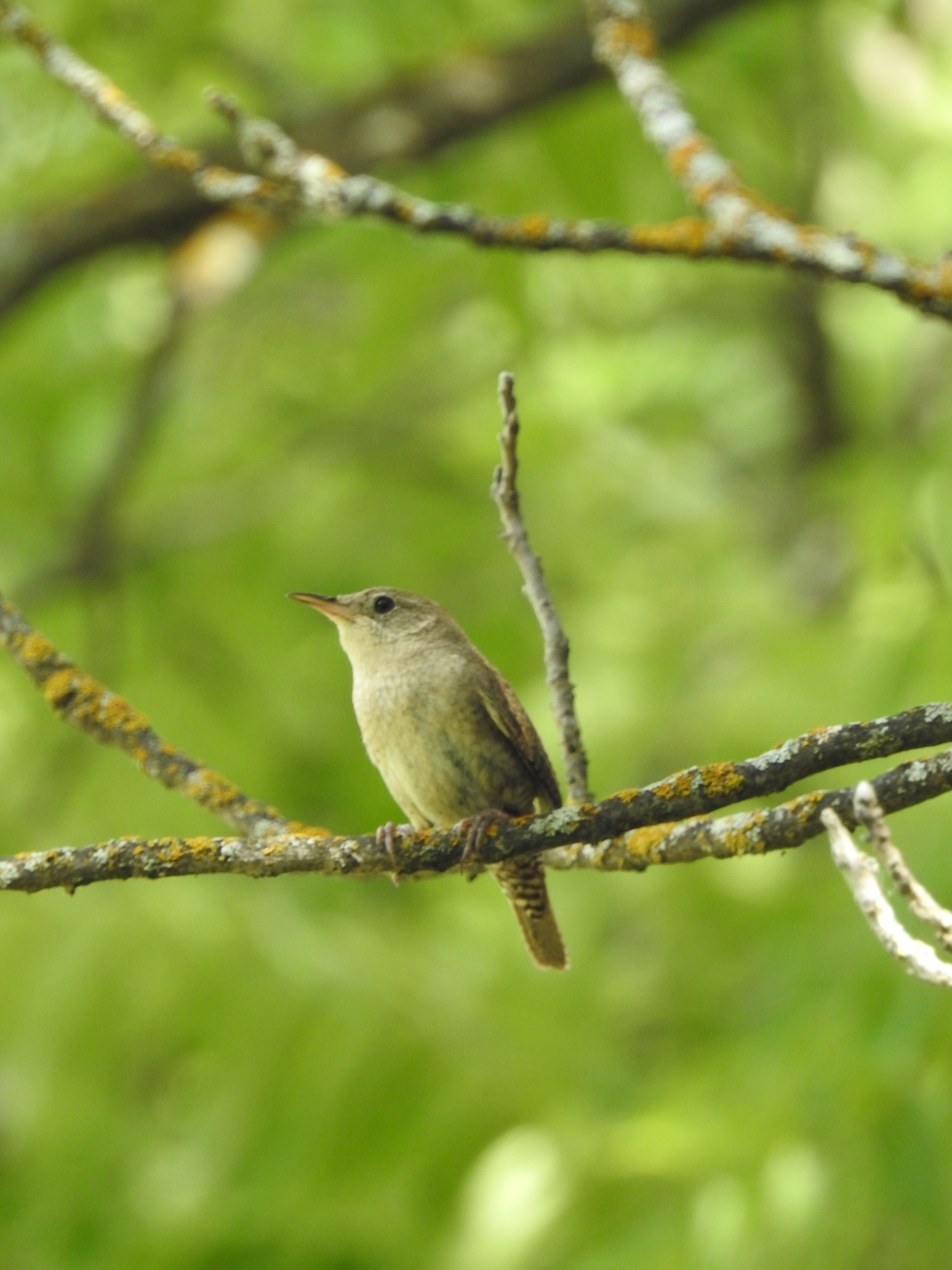
House wrens

House wrens on Smith Falls Creek. Photos by Jessa.