Showing posts with label cats. Show all posts

Monday, May 17, 2021

Sunday morning with a railroad cat

We got off to a slow start yesterday; there was plenty of work to be done in the back garden, but it was raining, and anyway Jessa woke up not feeling well, so we did ourselves a kindness and stayed mostly in bed with a couple of brief sorties for tea. Ellie eventually came to join us for a snuggle, and so did Cathan and Caiomhe, a contented pile of people and cats lounging on and under the goosedown blanket as Sunday morning stretched into Sunday afternoon. Just as Jessa started to think about getting up, Caoimhe, who had been lying on Jessa already, stretched out a paw and went to sleep.

My comment, "She looks just like Chessie," was met with blank stares from both my wife and daughter. "You have no idea what I'm talking about, do you?"

"Regional, or just because you're old?" Jessa teased. Well, both, apparently. I pulled up the Wikipedia page on Chessie to dispel their ignorance, and both Jessa and Ellie agreed that Caoimhe, whose appearance belies her five years, is a ringer for C&O's sleeping kitten.


We stayed in another half-hour at least.

Tuesday, November 22, 2016

This is our Switzerland

Many years ago, after my mom was diagnosed with ALS but before the disease completely robbed her of her mobility, she and my dad traveled to Switzerland. I'm sure that some people privately questioned the wisdom of their decision to go; I hope that no one had the ill manners to actually say so, but if they did, my parents wisely ignored them. It was, they knew, their first and last opportunity for a trip they'd long dreamed of taking, and in the years that followed, the memories of that trip together must have been a source of strength and joy when so much else was against them. I know they never for a moment regretted it.

...

A little over two years ago, Jessica contacted Don Ryan with the Irish Hawking Club to inquire about attending one of their field meets. She had always wanted to see Ireland, and wisely figured that falconry might be sufficient motivation to get me on a plane with her. Don told her we would be welcome any time, but suggested we wait for the 2016 meet, which would be a joint meet of the IHC and the IAF (International Association for Falconry and Conservation of Birds of Prey). And so she waited.

In those two years, we've each lost a job unexpectedly, and our finances have not improved appreciably. There were plenty of good reasons not to go on this trip, and I expect there are some people in our lives who would question the wisdom of our going. But having endured five years of voluntary poverty (she was solvent when she met me, and married me knowing which way "for richer, for poorer" was going to work out), Jessica was determined to have this trip. And there are some indications that this may be a now-or-never prospect for us as well.

So, this is our Switzerland.

...

We have dived right back into our life in Nebraska. Sunday morning, we were checking out of our hotel in Dublin; by Monday afternoon, Jess was back at work and I was out hawking at Pawnee Lake. (Our first hunt of the season, and good old Stekoa caught the first rabbit we saw.) I'll be back to work myself in a couple of hours, and it's the busy season, so time will be at a premium, but I intend to post photos and stories of our Irish adventure over the next couple of weeks as time permits.

Just two photos and one tiny story for now. Any lingering doubts we may have had dissipated when we saw our Aer Lingus jet at O'Hare in Chicago. We would be flying to the land of Jessica's ancestors on the Caoimhe, which is pronounced "Keeva" and which happens to be the name of our cat. A good omen...


Thursday, November 26, 2015

Much

A sampling, in no particular order and by no means all-inclusive:


Happy Thanksgiving to all...

Thursday, February 7, 2013

Kitties!

Chas aptly describes these pictures as "somewhere between 'very interesting' and Paleolithic nightmare territory." Click the link. Do it.

Wednesday, January 11, 2012

Cassowaries, and more of the world's most awfulest things

Duncan Wright at 10,000 Birds has a nice essay on his native land of Australia, a wonderful place where everything is potentially out to get you:

“You don’t have to move far off the plane to step into the danger zone. Lurking in the suburban lawns of Sydney are the deadly Funnelweb Spiders. Sharks cruise off the city’s beaches, and just yesterday a deadly species of snake was found in a suburban railway station. Further afield, there is a poisonous mammal, the platypus, many waterways are filled with the carnivorous Saltwater Crocodile, and a species known as the box jellyfish is so dangerous that it causes the closure of every beach across the entire north of the continent for several months each year, an achievement that the sharks can only look at in wonder.”

RTWT.

Jessica's comment was, "God made Australia so that most of the world’s most awfulest things can be easily avoided."

Meanwhile, we're limited to just a few statistically insignificant wildlife hazards, like the odd mountain lion... [Sigh.]


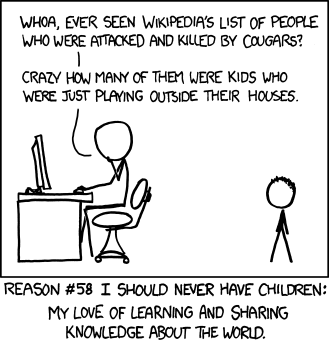
I'll save you the trouble...here's the list from Wikipedia.

Tuesday, August 9, 2011

E II R

Pendleton is the best-known marketer of trade blankets in the States, but credit for the creation of the blanket trade must go to "Canada's Merchants", the Hudson's Bay Company. Chartered in England in 1670 and headquartered at York Factory (now in Manitoba, but originally the commercial capital of Rupert's Land), HBC was established to compete with French fur traders and served for a time as the de facto government of British North America.


Along with firearms, cookware, beads, etc., European fur traders often paid their Native and Métis suppliers in wool blankets. The iconic HBC product is the "multistripe" or "candy-stripe" blanket, a white point blanket with headers in "Queen Anne's colours" of green, red, yellow, and indigo—although other blanket-makers (including Pendleton) copied this design, so closely is it associated with Hudson's Bay that stripes in those colours have been incorporated into the modern company's logos. Nevertheless, HBC point blankets were and are made in a variety of other colours, some of which have changed with the whims of fashion while others (notably red, green, and blue) have remained constant or nearly so.

The blanket below, royal purple with white points and headers, is a one-off design, made only in 1953 to commemorate the coronation of HM Queen Elizabeth II. It is consequently among the rarest of the 20th-century Hudson's Bay blankets, and to my mind one of the very prettiest.


[Label]


[Another regal personage]


Word has just come down, incidentally, that the Canadian Forces are reverting to their old names: Maritime Command will once again be known as the Royal Canadian Navy, Air Command will once again be the Royal Canadian Air Force, and Land Force Command will be simply the Canadian Army. Defence Minister Peter Mackay intended the renaming as a nod to the services' "proud history and traditions", but Canadian republicans have derided the move as "abject colonialism". [Links to BBC and CBC.] A reminder, either way, that among Elizabeth's titles is Queen of Canada.


[Link to the Museum of the Fur Trade in Chadron, Nebraska. Among their artifacts: the oldest known surviving point blanket.]

Monday, September 13, 2010

The color of cats

I like sled dogs. Yes, I keep dachshunds, and yes, I admire many other sporting breeds, but I also really like huskies and malamutes. Part of it is their utility, their love-to-work, please-can-I-pull-something come-on-let's-go-for-a-run-in-the-woods attitude. But another part is their looks: they look a bit like wolves. This does not mean that sled dogs are especially closely related to wolves—all dogs are closely related to wolves, and the resemblance between a husky and a wolf has more to do with convergence than with affinity. Still, I like the look, and on some level aesthetics do matter.

I've never considered myself a cat person, but I do have aesthetic preferences for some cats over others. My favorites have always been so-called mackerel tabbies, with irregular stripes in shades of grey that function well as camouflage. My friend Julie says she has trouble getting good pictures of her mackerel tabby, Pinduli, because her camera's autofocus won't lock on, so effectively do Pinduli's stripes break up her outline. That's my kind of cat—and I'm probably a bit slow for not figuring it out sooner, but there's a reason why.

Last summer, Scientific American published an article [official link here (full article only available to subscribers or for a fee), or full text without pictures here] entitled "The Evolution of House Cats". RTWT, but the scientific highlight is that, based on DNA analysis of various wildcat (Felis silvestris) subspecies and of domestic cats, multi-focal domestication has been ruled out in favor of one-time domestication of F. s. lybica in the Fertile Crescent, in conjunction with the rise of agriculture and the corresponding increase in house mouse (Mus musculus) populations.

Cultural change begetting ecological change begetting domestication... Fascinating stuff, but what really arrested me was the accompanying color photo of a wildcat: mackerel tabby. Of course! Without consciously knowing what a wildcat looked like, I had nevertheless gravitated toward wild-looking domestic cats.

Enter my daughter. Ellie has been begging Susan and me for years to let her have a cat. I'm not really sure how or why she became fixated on cats—it's not as though we've ever had a shortage of critters around the house—but the presence of those other critters was always (might still be) a valid excuse for saying no. In the end, though, and despite Susan's allergy to cats, Ellie wore her down. And then the two of them wore me down. So I agreed (reluctantly) that we might have a cat, but suggested that it might be better if that cat looked like something out of the wild.

Boy howdy, did we end up with a wild-looking cat. Here's the recipe:
  • Cross a Siamese and an Abyssinian and you get an ocicat, a spotted domestic.
  • Cross a domestic cat and an Asian leopard cat (Prionailurus bengalensis) and you get a Bengal cat.
  • Now cross an ocicat with a Bengal cat and you get a cheetoh.
  • Cross a domestic cat (usually a spotted breed like an Egyptian mau or a Bengal) with a serval (Leptailurus serval), a wild cat often kept as a pet in Africa, and you get a savannah cat.
  • Finally, cross a cheetoh and a savannah cat and you get a "cheevannah".
If F1 crosses were used at each step—which of course isn't likely—the resulting cheevannah would be five parts domestic, three parts wild (two grandparents would be servals, one an ALC). Even with that wild blood diluted by using later crosses, the cheevannah looks quite exotic: Ellie's cat, Challa (not challah like the Jewish bread), has a reddish stripe down her spine, spots on her sides, stripes on her legs, and rings on her tail. She might or might not end up with cheetah-style teardrop markings below her eyes.


Challa is very social, yowling pitifully whenever she's left alone, and following us like a puppy whenever she's not. Her idea of play is all about stalking, pouncing, clawing, and biting, but she seems to have learned (after being sprayed with water a few times) that our finches and sparrows are better left alone. And after several carefully supervised introductory sessions, she and the dogs seem to be getting along fine. It's been an interesting experiment, and it's gone much more smoothly than I had expected.


And yes, despite all the scratches on my hands, arms, and legs, I'm really enjoying the wild child.

Friday, January 25, 2008

Cat in the field

Today's a day off, but yesterday I took my redtail Stekoa (an intermewed passager, of indeterminate sex but probably a tiercel) to one of our favorite hunting spots, a mixed-grass meadow liberally dotted with eastern red-cedar trees. Released from his travel box, he took a perch atop one of the cedars, and almost immediately started chasing what I assumed was a cottontail. His intended quarry made it to another large cedar before he could close, so he pitched up and landed atop the same tree. Peering underneath, I found not the expected rabbit but a feral cat.

Cats are dangerous: redtails can and occasionally do catch them, but the bacteria harbored in cats' claws are deadly to hawks and other birds; even a small scratch, if not noticed and treated, can cause a deadly infection. So I did my best to encourage the cat to depart in a direction that afforded the best possible cover and the slightest chance of detection by Stekoa. But what I really wanted -- and I don't often feel this way in the field -- was a firearm.

State wildlife agencies used to encourage hunters, via the regulation manuals issued with hunting licenses, to shoot cats found in the field. They still should. Unfortunately, such recommendations are no longer considered tactful, or politically correct, or something along those lines. But it remains damned good advice for those of us who care about wildlife. Researchers estimate that cats kill billions (yes, billions with a "b") of native birds and rodents every year -- and a fair number of rabbits as well.

This is a brand-new blog, so I'm not expecting to be flamed, but let me preempt some of the likely attacks anyway:

"It's not the cat's fault it's out there." True enough. The cat is someone's responsibility, or was until they abdicated it. But it's not about "punishing" the cat; it's about protecting wildlife, particularly on public land. (I'd have to check my map to find out whether this particular spot is a State Recreation Area or a Wildlife Management Area, but both SRAs and WMAs are supposed to be managed for game and non-game wildlife.) The cat has no business being there, and should be removed as expeditiously as possible -- which usually means shooting.

"How is the cat any different from your hawk? They're both predators." Again, true -- but only up to a point. The hawk is a native predator, part of the same ecosystem as the birds, mice, and rabbits I'm concerned about. The cat, on the other hand, is an exotic species introduced by man. Again, it has no business being there. (Note that I would not be complaining about a native felid. We have bobcats and even cougars in the area, and they can eat all they want. I'd be delighted just to see one.)

"But," someone might argue, "your hawk isn't really wild." Okay... He was trapped from the wild, and will most likely be permanently returned to the wild someday, but he is currently "under my control" -- an introduced predator in the sense that I gave him a ride to the cedar meadow yesterday. But I help to pay for the management of that land by my investment in hunting licenses, habitat stamps, and park permits; consequently, I have certain rights on that land, including the right to hunt game species, in season, by legal methods which include falconry. The cat's (former) owner, on the other hand, is not hunting with his or her cat. It's not legal, or even feasible, to do so. That individual has merely shrugged off his or her responsibility and inflicted this non-native predator, year-round until it is finally hit by a car or meets a bigger, tougher predator, on an ecosystem to which he or she evidently feels no connection.

"You just don't like cats." A big assumption, and irrelevant in any case. For the record, I'm fine with cats kept indoors. Many of my friends have cats, and a couple entrust their care to me when they're out of town. But housecats belong in houses, and unless someone starts shooting the idiots who "release" them into the wild (and the well-meaning but even more misguided individuals who set up feeding stations for feral cats, often in or near sensitive areas), shooting and trapping feral cats is the only way to mitigate the environmental damage they do.

Postscript: As it happens, Stekoa didn't see the cat depart, and we soon got a rabbit going. He missed that one -- which is altogether routine -- but caught another cottontail a short while later, which I'm happy to say is also routine. I thanked Rabbit, Stekoa had dinner, and we went home.