Sunday, December 4, 2011

photoblogging: NSOC meet, December 2011

For my friend, currently in California, who had to miss the snow-and-gravel cruise:

Vinyl makes them faster:
  • Rick's RS 2.5
  • Jesse's lifted WRX
  • Jon's swapped Impreza


Action shots:
  • Trevor's Alcyone SVX
  • Rick's RS 2.5 and Tank's Forester
  • Tank again
  • Not sure who this is, but that's not a mismatched bumper, it's masking tape


Going to the dogs:
  • Harper D.
  • Bayard wants to drive
  • Harp again, just because she's awesome


Saying goodbye to a friend:


Miscellaneous shots:
  • Nice wheels
  • Three Subarus in their natural habitat
  • One more of Harper, again because she's such an awesome dog


Thursday, November 24, 2011

A happy Thanksgiving

A purely personal note:

Bleak history notwithstanding (see below), I still believe Thanksgiving is very much worth observing, and should not necessarily be restricted to a single day in November. In my view, in fact, to give thanks is the only form of prayer that really has much validity or meaning. That's not to say, of course, that I never pray for strength or wisdom or luck, but when one asks for things from the powers that be...well, that can be a long wait for a ship that may not come. It seems to me, though, that anyone—regardless of their faith or spiritual traditions—may have cause to be grateful from time to time.

I wouldn't have believed it some months ago, but I find now that I have much to be thankful for. Most of the entries on my mental list are people, and many of them are readers of Flyover Country. I won't embarrass anyone by singling them out, and won't risk hurting anyone's feelings by leaving them out, so let me just say a general but very sincere thank-you to everyone who has offered their love and support, in person or at a distance.

Life is good, and looking better as time goes on, and I am truly thankful to be here.

Fifty-five years: a Thanksgiving story

Every American knows the story, or thinks so at any rate. In 1620, religious dissenters from England sail to the New World in a small ship, Mayflower, find a natural harbor, and establish the new Plymouth Colony, where they hope to build a new life and worship freely according to their precepts. Half of the unprepared colonists die the first winter. Local Indians take pity on the colony, teach them to plant and fish, the colony takes hold, a great feast of thanksgiving is held, etc., etc. And the story is true, as far as it goes. Of course, it doesn't usually go very far.

Plymouth Colony was not hacked out of the wilderness, but built on the site of an abandoned Indian village known as Patuxet. Epidemics from Europe had spread through the Native populations in what was to become known as New England, greatly reducing Native numbers and depopulating Patuxet entirely. The English Pilgrims did not encounter a single Native until March of 1621.

That first Native was Samoset, not a local but a visiting Abenaki from the coast of what is now Maine. He had met Europeans before, fishermen, and greeted the startled Pilgrims with the words, "Welcome, Englishmen." He soon returned with an acquaintance, named Squanto, who possessed greater fluency in English and was a local. Born and raised in Patuxet, he had been kidnapped some seven years earlier by an English slaver and sold into bondage in Spain. Ransomed by Spanish monks, Squanto eventually made his way to England, befriended a wealthy merchant who taught him the language, and later took passage to Newfoundland. Returning south to his home village, he found Patuxet deserted and took up residence among the Wampanoags at their principal town, a place called Montaup.

It was Squanto who eventually stayed at Patuxet/Plymouth, gave the Pilgrims both seed corn and instruction on how to grow it, and shared his skills in hunting and fishing. It was also Squanto who introduced the English leader, John Carver, to the sachem of the Wampanoags: Usamequin, better known as Massasoit.

Massasoit was a man faced with a dilemma. Beset by disease and therefore weakened militarily, the Wampanoags and their neighbors had been losing ground to another local nation, the Narragansetts. But Squanto, who had lived amongst the whites in Europe, suggested that an alliance with Carver's Pilgrims might help the Wampanoags restore the balance of power. So Massasoit and Carver struck a treaty, each pledging to support the other if attacked by a third party.

With the successful harvest of 1621 came a three-day celebration, attended by all the surviving Pilgrims and about ninety of the Wampanoags. There was feasting (probably more venison than turkey, plus corn and other produce), prayer, footraces, wrestling matches, and quite possibly lacrosse games. The first Thanksgiving of legend...

Alas, the harmonious relations were not to last. Protected by the treaty with the Wampanoags, and with its food supply secured, the Plymouth Colony expanded over the years. Many Wampanoags were not entirely thrilled with the further concessions of land made by Massasoit. Worse, the colonists increased in arrogance as they increased in number. They were less interested in freedom of religion as an ideal than in freedom to exercise their religion, and impose it on their Native neighbors.

Massasoit died in 1662, and was succeeded as sachem by his son Wamsutta, known to the English colonists as Alexander. Wamsutta was far more skeptical and far less patient with the colonists than Massasoit had been, and after a year or so as sachem he was abruptly summoned to Plymouth by the Pilgrims. He fell ill, and died on his way back home to Montaup; many Wampanoags believed (and many of their descendants still do) that he had been poisoned.

Wamsutta was in turn succeeded by his younger brother Metacom; his English appellation was King Philip. Like Alexander, Philip was arrested and hauled off to Plymouth—several times—but apparently was clever enough to avoid being poisoned. While he cooperated with the colonists just enough to maintain his autonomy, he secretly began to organize resistance to the English, approaching even traditional Wampanoag enemies to build a coalition against the whites.

When, in 1675, the English hanged three Wampanoags, open hostilities broke out. The first engagements were spontaneous, taking even Philip by surprise, and soon the war spread beyond Massachusetts throughout New England. Settlers panicked, and even "accultured" Indians who had converted to Christianity were under suspicion; many were imprisoned in what amounted to concentration camps. Even the Narragansetts were drawn into the war, on the side of their former enemies the Wampanoags, after English settlers attacked a neutral Narragensett town and massacred its inhabitants.

Despite their early successes, the tide soon turned against the by-now outnumbered and more lightly armed Natives. In April of 1676, Canonchet, sachem of the Narragansetts, was captured and executed by an English firing squad. Soldiers captured Philip's wife and son in August of 1676; they were condemned by the Pilgrim clergy in Plymouth and sold into slavery in Bermuda. Shortly thereafter, Philip himself was killed an a brief fight at Montaup, his home village and long the center of Wampanoag power. That power no longer existed: by the end of "King Philip's War", fifty-five years after Massasoit and John Carver celebrated "the first Thanksgiving", almost all of the Native people in New England had been killed, sold into slavery, or exiled to Canada.

Saturday, October 29, 2011

NFA field meet, October '11

Not a typical meet, as warm weather and other factors prevented us from doing any actual hunting last weekend. We kited a couple of the falcons, did some manning and creance work with new hawks, and otherwise kicked back. I'll remember this meet for archery, knife-throwing, and Chinese checkers as much as anything. (Also the sugar- and creamer-packet fight with Kelly.) It was good to be back at the Schneidereit place after too many years away; good also to see that Ivan has a beautiful family and that this piece of land will remain a treasured family ranch for at least another generation.

Photos follow...


"Give Me Something"

Monday, October 24, 2011

Unexpected

The eyes of the doe are perfect.
Large, luminous, liquid, lovely,
they reflect the world through which she walks
and yet do not reflect the world's nature,
for they are perfect,
and the world is not.
The eyes are pools of beauty,
and even deeper is the spirit behind.
The spirit knows things the doe cannot.

Her sistren are apt to be taken down
by those who speed through the world unmindful
of their impact on the gentle and the sensitive
and the beautiful.
But the spirit guides her clear.
The wolves are long gone from these parts,
the cougars barely a rumour,
but never having seen them, she picks her way through the woods
still aware.
No way to tell, looking at those eyes
brimming with innocence and wisdom,
how many winters she's seen,
or if she's seen winter at all.
The spirit has seen them all.

And yet even the spirit can be taken by surprise.

Cupid is not flitting around
flashing his pink bottom at the world
and making the woods ring with childish laughter.
Cupid is up a tree,
quiet,
with paint on his face
and strips of rags hanging from his clothing
that move like leaves in the autumn wind.
And wary as she is
of wolf and cougar and all the hazards of the world,
not everything can be planned for.
And one day she will stand just so,
and the arrow may find its mark.

Monday, September 26, 2011

Trapping weekend

The guiding concept for our expedition was simple: Trapping hawks is fun, but trapping hawks socially is even better. The strategy was not a whole lot more complicated: a western party led by Anita Johnson would meet up at Kearney and trap their way eastward, while an eastern band led by yours truly would start at Lincoln and trap our way westward—and if all went according to plan, we would meet up somewhere in the middle. So simple, even falconers can do it. There was only one worry: Even as Donna Vorce and I were planning this trip, we were aware that September is too early to expect to see many passage redtails. On the other hand, we reasoned, it doesn't take many if you can be confident of catching the few you do see. Long story short, we got lucky enough.

[A bird in the hand is better than...anything. My photo.]


One reason we scheduled the trip so early in the season is that NFA has several apprentices this year; the hope was that, if they took hawks this weekend, they might have them hunting in time for the NFA field meet a month from now. Well, the pressure is on now: Three apprentices were looking for birds this weekend, and by Sunday evening, all three had new redtails.

We trapped the first, a nice little tiercel, shortly before sunset on Saturday, and though it had been a long and unproductive day to that point, suddenly none of us felt tired. A moment of silence was observed for the pigeon that brought the tiercel to us. Then, as dusk fell and we loitered on the little-traveled rural road, visiting amongst ourselves and trading stories of the day's misadventures, a pair of killdeer, a flock of Canada geese, a bald eagle, and a coyote—all unseen but unmistakable—added to the sound of human conversation, and we were reminded how good it is to be outdoors on a glorious autumn evening.

[Dusk in the Platte River Valley. My photo.]


After dusk had turned to full-on darkness, the trapping parties went their separate ways. Anita, Doyle Daiss, and Chris Remmenga all had places to be, and so departed for their respective homes. Apprentices Caleb Schwartzkopf and Tyler Meitl headed for North Platte, set to trap again on Sunday with sponsor Art Graves. The rest of us (Donna, Pat Stull, my apprentice Amanda Kaufman, her sisters Cassie and Kelly, and me) drove to a nearby WMA, with Amanda's new tiercel hooded and trussed up in a nylon stocking. Upon arrival, Amanda and I put anklets and jesses on the hawk while Donna, Pat, and the girls set up camp.

There's something about camping—the movement necessitated by chores, the murmur of conversation, the ability to choose bright light or darkness or anything in between just by moving closer to or away from the fire—that is uniquely conducive to manning hawks. And if there's a more enjoyable setting in which to man a freshly-trapped hawk than by a campfire, surrounded by friends, I can't imagine what it would be. We snacked on apples and crackers and cheese and venison, we watched the sky, we talked late into the night, and we handled the tiercel, getting him accustomed to the sounds (and, briefly, sights) of camp life, easing him into his new world. Finally, in the small hours of the morning, we put the newly-named Azazel in his box, unrolled our sleeping bags beneath an impossibly clear sky shotgunned with stars, drifted off to the soft trilling of a screech-owl, and slept the sound sleep of the contented and exhausted.

[A girl and her hawk: Amanda with Azazel. My photo.]


The next morning we awoke to a kingfisher rattling through our camp and two ospreys gliding overhead. Azazel got some more manning time, Pat and Donna went on a coffee run, and we unhurriedly broke camp. Doyle rejoined us for a couple hours of desultory "trapping", if it can be called that when we caught nothing, and then we all headed home. Elsewhere, Art's group was still at it: Caleb trapped a female redtail on a pigeon harness Sunday morning, and Tyler scored a tiercel on a bal-chatri Sunday evening—again, in the last moments of daylight.

So, a success if not a rousing success: Three hawks sought, three hawks caught, and a good time had by all. Donna and Doyle will be out trapping again in a couple of weeks when their schedules are more conducive to training. If I join them, I'll post that up as well. Meanwhile, we're already discussing making this trip "the first annual". We might shoot for later in the season, we might add some different trapping styles to our repertoire, but for certain we'll be doing this again.

[Taking my turn with the manning. Photo by Pat.]


The camping group. L-R: Donna, Amanda with Azazel, Mark, Cassie, Pat, Kelly. Photo by Pat.]


[Azazel. Photo by Pat Stull.]

Wednesday, September 21, 2011

"So. Central Rain"

R.E.M. have left the building.

The band broke up today.


Here's a nice version of what may be my favourite R.E.M. song:


The correct pronunciation, if you happen to be wondering, is "Southern Central Rain".

Sunday, September 18, 2011

Stellaluna and Wilbur will kill us all: a review of Contagion

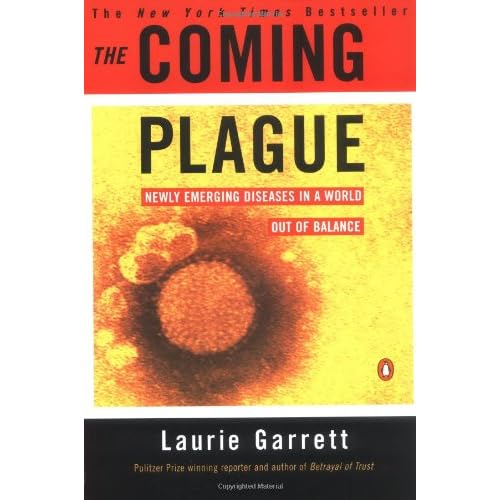
It will come as no surprise to anyone who knows me that (when time permits) I read a lot of books on science. My friends are, however, sometimes surprised by my collection of "scary disease books". I have books on plague, books on smallpox, books on Ebola. Sensational popular science writing like Richard Preston's The Hot Zone and The Demon in the Freezer, insightful memoirs by noted virologists like Joe McCormick and C.J. Peters, historical analyses like Scourge and Justinian's Flea. The one I go back to over and over again, though, is Laurie Garrett's The Coming Plague, an engagingly-written, exhaustively-documented overview of the field of emerging diseases.


The Coming Plague addresses not just emerging diseases and the microbes that cause them, but often the ecological circumstances that lead to a zoonotic outbreak. For example:
  • A political revolution isolates a region devoted primarily to ranching from its usual markets. Out of necessity, the ranchers become farmers, clearing and plowing land to grow crops for which they had previously traded. A formerly uncommon mouse, its original habitat disrupted but suddenly presented with a superabundance of food in the form of corn, increases greatly in numbers and begins to live commensally near humans. The mouse sheds a virus in its urine, and half the people in town become infected through eating contaminated food or breathing in dust from swept floors; half of those people die bleeding. This is Machupo, or Bolivian hemorrhagic fever.
  • After several years of drought in the already dry Four Corners area in the southwestern United States, a winter of heavy snowfall brings an infusion of moisture. The following spring and summer, vegetation rebounds, and piñon trees take the opportunity to produce a large seed crop. Deer mouse populations explode due to the sudden abundance of food, and as in Bolivia the mice increasingly come into contact with humans, shedding virus in their urine. Again, people die, this time gasping. This is Sìn Nombre or Muerto Canyon virus, a previously unknown hantavirus that causes acute respiratory distress syndrome.
  • The practice of hunting primates for bushmeat allows a virus from infected chimpanzees to enter human hunters or butchers, probably on several different occasions at different times and places. The chimpanzee virus adapts to its human hosts, becoming a new species (or two) in the process. The construction of a transcontinental highway and an attendant increase in travel, prostitution, and intravenous drug use allow the virus to expand its range beyond central Africa. People die rotting, unable to fight off viral, bacterial, and fungal infections. This is HIV and the global AIDS pandemic.
Varied and wondrous are the diseases in The Coming Plague. Some are widely known, and widely feared, by the general public. Others are widely known but taken all too casually. And still others are obscure, perhaps mercifully so. There exist, for example, a herpes virus found in squirrel monkeys, and another in spider monkeys, that seem to do their hosts no harm whatsoever. But when these viruses are transmitted to Old World primates, they trigger devastatingly lethal leukemias and lymphomas. Not scary enough for you? Okay...but these cancer-causing viruses are airborne.

* * *

So I was anxious to see the new Steven Soderbergh movie Contagion, but also a bit apprehensive that it might disappoint me, that it might get the science wrong or gloss over the science altogether. I'm happy to report that Contagion does not disappoint. Like The Coming Plague (it turns out that Laurie Garrett was a consultant on the movie), it tells a very scary story without sensationalizing it.

Basic plot summary: Scattered individuals fall ill with what appears to be a respiratory infection but rapidly escalates to meningitis or encephalitis. These isolated illnesses develop into clusters, which grow into a global pandemic. Mayhem ensues. The movie follows a few patients, as well as doctors from the CDC and WHO and others struggling to avert, understand, and ultimately survive the emerging crisis.


On both an individual and societal level, the film gets human nature right. An excellent cast helps: the big names are Matt Damon, Gwyneth Paltrow, Laurence Fishburne, Kate Winslet, Elliott Gould, and Jude Law, but many other fine actors breathe life into believable and variably sympathetic characters. No mustache-twirling villains here; the closest approach is Law's character, a blogger ("six million hits a day") with a penchant for conspiracy theory who is not immune to corruption, but he seems to be more self-deluded and opportunistic than willfully evil.

Likewise, the public-health worker (played by Chin Han) who conspires to abduct a colleague from the WHO (Marion Cotillard) has a reasonable and sympathetic motive: a hostage from among the world's medical elite makes it less likely that his village will be overlooked if and when a vaccine or treatment is developed.

The most despicable character is actually Paltrow's philandering patient zero, but while her misconduct does give the virus additional opportunity to spread, her benign conduct is just as destructive. This raises the point that, while the virus is certainly the major antagonist in the film, it is not really a villain in the usual sense. A virus lacks any sort of consciousness, knows nothing and cares nothing of human concerns. Terrifying in its effects, it is nevertheless not malevolent, it just is—life (or proto-life) at its most basic, replicating itself and incidentally leaving destruction in its wake, facilitated by the frequent contact within dense human populations and the ease and ubiquity of global travel.


I went into the movie looking for errors. Happily, I didn't find any. I'm just an interested layman, of course, but as far as I could tell, all the virology and epidemiology was spot on. The specific virus depicted in the movie (MEV-1) is entirely plausible, enough so that "hypothetical" seems a better descriptor than "fictional".

The film's commitment to realism extends to dialogue in which doctors talk to other doctors like doctors. A lesser movie, for example, might include a line such as "We should isolate the patients with higher fevers; they may be more contagious." Obviously another doctor would know this, and so the line is intended as explanatory dialogue for the audience. In Contagion the line is "Put the more febrile patients down here"—no explanation necessary for medical personnel, and so none given to the audience, who may or may not have "febrile" in their working vocabularies. When explanatory dialogue is included, it's always in a believable context: for example, the EIS officer defining R0 ("R-naught", a measure of transmissibility) to bureaucrats in a state health agency who are clearly not themselves epidemiologists—they are considering postponing the declaration of a state of emergency because it might adversely affect holiday shopping.

The drama in the film is never overplayed. Plenty of people, including major characters, die in the movie, but Soderbergh stays away from the usual format: a close-up shot of the patient, loved ones in emotional anguish nearby, sad violin music playing just in case we were about to miss the point. Contagion shows death more matter-of-factly, and more starkly: a delirious patient staggering into the road and being hit by a truck; a child left alone and found unblinking and lifeless in his bed; a doctor, discovering that she has contracted the disease, arranging for her contacts to be traced in one scene, and encased in a body bag, about to be interred in a mass grave, in the next. Combined with Soderbergh's refusal to dumb down the dialogue, this approach gives Contagion the gravitas of a documentary without making it any less a thriller.

Ultimately, the scariness of Contagion lies specifically in its realism. It is, in a sense, the opposite of The Andromeda Strain, which offers an easy deal: suspend your disbelief for as long as it takes to read the book or watch the movie, in exchange for some dramatic tension. This film is a wake-up call: Steven Soderbergh, Laurie Garrett, and the other people involved in making Contagion are using dramatic tension to try to dispel disbelief. The next big disease that will threaten humanity's existence, or at least life as we know it, is not an exotic life-form from outer space, waiting to hitch-hike on a probe returning to earth. It's here already. EVF-1, or something like it, is just waiting for a small ecological change to unleash hell on earth. The message of The Coming Plague, and of Contagion, is that it's not a question of if, but when.

Sunday, September 11, 2011

Tuesday, August 9, 2011

E II R

Pendleton is the best-known marketer of trade blankets in the States, but credit for the creation of the blanket trade must go to "Canada's Merchants", the Hudson's Bay Company. Chartered in England in 1670 and headquartered at York Factory (now in Manitoba, but originally the commercial capital of Rupert's Land), HBC was established to compete with French fur traders and served for a time as the de facto government of British North America.


Along with firearms, cookware, beads, etc., European fur traders often paid their Native and Métis suppliers in wool blankets. The iconic HBC product is the "multistripe" or "candy-stripe" blanket, a white point blanket with headers in "Queen Anne's colours" of green, red, yellow, and indigo—although other blanket-makers (including Pendleton) copied this design, so closely is it associated with Hudson's Bay that stripes in those colours have been incorporated into the modern company's logos. Nevertheless, HBC point blankets were and are made in a variety of other colours, some of which have changed with the whims of fashion while others (notably red, green, and blue) have remained constant or nearly so.

The blanket below, royal purple with white points and headers, is a one-off design, made only in 1953 to commemorate the coronation of HM Queen Elizabeth II. It is consequently among the rarest of the 20th-century Hudson's Bay blankets, and to my mind one of the very prettiest.


[Label]


[Another regal personage]


Word has just come down, incidentally, that the Canadian Forces are reverting to their old names: Maritime Command will once again be known as the Royal Canadian Navy, Air Command will once again be the Royal Canadian Air Force, and Land Force Command will be simply the Canadian Army. Defence Minister Peter Mackay intended the renaming as a nod to the services' "proud history and traditions", but Canadian republicans have derided the move as "abject colonialism". [Links to BBC and CBC.] A reminder, either way, that among Elizabeth's titles is Queen of Canada.


[Link to the Museum of the Fur Trade in Chadron, Nebraska. Among their artifacts: the oldest known surviving point blanket.]

Saturday, July 30, 2011

An observation

Of all the things you wouldn't want to fall out of your kitchen cabinet, to deflect off the countertop and shatter on the floor...

...a large glass bottle of Karo syrup would have to be near the top of the list.

Particularly if the floor was already strewn with spilled bird seed.

Monday, July 11, 2011

First love in second growth

Emma Maris has a nice post over at The Last Word On Nothing entitled "Coming of Age in a Trash Forest", about secondary forest contrasted with "The Big Pristine". RTWT, but the final paragraph is the one that really got me:

My unscientific guess is that upwards of 80% of ecologists and conservationists first learned to love nature in places that weren’t pure, pristine or wild: culverts in cul de sacs, empty lots, summer camps on formerly logged land, hedgerows and the weedy margins of agricultural fields. We loved them as kids, and now we are learning to love them again as scientists and environmentalists. It is a kind of homecoming.

I'm definitely an eighty-percenter. Most of my childhood was spent in the decidedly more rural environs of Loch Raven, but the first piece of ground to attract my attention as a young naturalist was in Catonsville, Maryland, on a street named for a long-defunct convent which, I suspect, left the neighborhood poorer for its absence. This was a long-settled and densely-populated area that was entering a period of decline. (When I returned years later with childhood friend Joann Grimes, we discovered that, apart from everything being smaller than we had remembered, the lane had made the slide from "somewhat sketchy" to a decidedly Not Good Neighborhood.) Across the street were quad-style apartment buildings, but ours was a Baltimore-style rowhouse, albeit without the marble steps.

Rowhouse residents parked in an alley behind the elongated building; the car I remember best was "Uncle" Carmine's (my friend Cindy's uncle, but he was Uncle Carmine to every kid on the block) Chevrolet Vega, distinguished by its bumper sticker: "You toucha my car, I breaka you face." (With Carmine, at least, the threat of violence could be taken as a joke.) But beyond the dusty gravel of the alley and up a red-clay embankment lay "the woods".

The woods, along with a small meadow on the other side, were the only "wild lands" accessible to the kids of the neighborhood. Here were built innumerable tree-forts, which lasted until blown apart by summer thunderstorms, pulled down by winter snowfall, or (most often) cannibalized to built bigger and better forts.* Here we could play at Tom Sawyer and Huckleberry Finn, though in retrospect I doubt many of the neighbor kids were literarily inclined. And here, just a stone's throw from my back door, was Nature itself—not just pictures in a field guide, but actual living things that made field guides worth carrying around.

Rank and weedy as they were, the woods tasted fine. There were honeysuckle vines (one of which, on an isolated section of chain-link fence that marked an abandoned right-of-way connecting to the alley, Bobby Quigley and I accidentally set alight with percussion caps one autumn day), blackberry tangles, and abundant mulberry trees. I'm sure many adults would have welcomed the demise of the neighborhood's mulberry trees (as long as it required little or no effort on their part), for the berries left purple stains on everything: cars, sidewalks, laundry hung out to dry, and quite often the faces of their progeny. But to a kid, the stains are worthwhile: nothing beats the taste of sun-warmed, bordering-on-overripe mulberries fresh from the tree in which you are perched watching the birds.

And snakes. The woods were home to a few black rat snakes (Elaphe obsoleta in the books I grew up with, though I see the species has now been renamed Pantherophis obsoletus) and abundant eastern garter snakes (Thamnophis s. sirtalis). I kept both of those, but my favorites were the diminutive Dekay's snakes (Storeria dekayi) and even more delicate, even more exquisite ringnecks (Diadophis punctatus). I never kept any of them for long, and some of them not even as long as I intended, for the Dekay's in particular were talented escape artists. My little brother had a collection of rubber snakes, lizards, and turtles, and as I recall it was one of my prodigal Dekay's that startled my mom late one night as she was picking up after Greg in the basement. I was awakened by my dad to remove the not-rubber-after-all snake, but he had a hard time concealing his amusement.

Berries and birds and snakes were everyday finds, but once I got really lucky and found a fossil on the edge of the woods: a chunk of mudstone covered with scallop impressionsChesapecten, I've always assumed. (I still have it somewhere, and will post a picture later if I can remember which box it's in.) For a typically dinosaur-besotted little boy, this was a red-letter day. It wasn't Montana or Utah or Mongolia, just the inner suburbs of Baltimore, but my woods had fossils!

[Found it!]


As far as I know, the woods are still there. My parents bought into the rowhouse for $15,000, give or take, about 1971; the unit next door was recently sold for something between $175,000 and $185,000 (thank you, Internet!). I'm not sure if that represents a neighborhood renaissance, an overheated mid-Atlantic housing market, or simply forty years of inflation, but I'd be willing to bet the woods are still weedy and at least as litter-strewn as when I was a kid. And I'd be equally willing to bet there are still birds and snakes and maybe even fossils waiting to be found there. What I don't know, in this age of nature-deficit disorder, is whether there are still kids who get off the couch (thanks again, Internet, and video games, and cell phones...) and explore those woods. No bet this time, but I sure hope there are.

* Quote from Emma Maris: "The nice thing about secondary forest is you can pound nails into it." I considered making this the title of my post.

Wednesday, June 29, 2011

Wings over Wimbledon

Hawking-for-hire: It's not just for airports and orchards anymore, as this BBC report indicates. The All-England Tennis Club has engaged a Harris' hawk to keep pigeons off the courts during the Wimbledon tournament.

Saturday, June 25, 2011

Subaru flip book

Okay, the giant mechanical spider is a bit cheesy, but the film technique in this Subaru Canada advertisement (by ad agency DDB Canada and Starz Animation) is creative, eh?


This was shot at Cayuga Speedway near Toronto, with the camera car zooming past 760 frames of animation to generate the kineographic effect. The image floats around a bit as the car accelerates, but then holds steady and in-focus as the driver maintains a precise speed and distance from the wall. Here's the making-of-the-video video:


Special bonus: This film, also by DDB for Subaru, will bring back memories for a few people who have been with me without a hawk in the car. Right, Ev?

Tuesday, June 21, 2011

Gyrfalcon miscellany

Just a few quick links:

From BBC Nature, this report on gyrs (east Greenland gyrs, anyway) as "secret seabirds", spending much of the winter on ice floes in the open ocean. While it has long been known that gyrs in coastal areas prey on seabirds, the species as a whole is considered to be dependent on ptarmigan—their ranges (omitting the new data from Kurt Burnham and Ian Newton) are almost entirely co-extensive. Apparently, however, some gyrs may specialize in seabirds year-round, not just when they are concentrated at rookeries during the breeding season.

Speaking of gyrs and ptarmigan, The Peregrine Fund hosted a conference last year on how climate change might affect the gyr and its prey species. This link is essentially an announcement of the conference, but I'm hoping it will eventually be updated to include the proceedings.

And here is the best of several gyrfalcon posts by Clare Kines at his blog, The House and other Arctic musings, which I am duly adding to my blogroll. HT Luisa at Lassie, Get Help.


Update: HT Steve at Querencia for reminding me of this story (BBC Nature again) on an ancient gyrfalcon eyrie.

Friday, June 17, 2011

The wild downtown

In a recent column in the Lincoln Journal Star, local historian Jim McKee noted that Lincoln's first high school, built in 1870, was considered by some parents to be too remote. The worries: grassland fires and bear attacks. The Pershing Auditorium now occupies that site, on Centennial Mall (as that segment of 15th Street is called) between M and N Streets, in the heart of what is now considered downtown Lincoln. There has been much discussion about tearing down the Pershing, which is showing its age and about to be made redundant by a new civic center, but no one worries much about grizzly bears or "the red buffalo" anymore.

On the other hand, the downtown area does have some patches of green. Some of the little sidewalk oases are full of roses and tulips and the like, but more than a few utilize native grasses (notably side-oats grama and prairie dropseed) and wildflowers. These I especially appreciate, as I've recently started working downtown. Although I've had jobs that took me downtown (Baltimore and Atlanta) on a regular basis, never before have I actually worked in a downtown high-rise building, and it's taken some getting used to; the little squares of prairie grass (like the peregrines soaring overhead) help to make the concrete canyons tolerable.
[Outside the Great Plains Center, Seaman the bronze Newfoundland waits patiently among native grasses while bronze Lewis and bronze Clark get directions from a bronze Otoe man. The Jefferson medal (originally in bronze) is a nice touch, don't you think?]


The urban environment presents unique challenges, but the folks who manage these little spots deal with the same fundamental paradox that confronts farmers, gardeners, and land managers everywhere else: the simultaneous difficulty of getting some things to grow and other things not to grow. I'll admit to having surreptitiously yanked a couple of weeds out of the ground myself: most pedestrians wouldn't recognize prickly lettuce or western salsify or common purslane growing among the prairie plants, and wouldn't much care if they did, but their presence offends me. While the concept of "ecosystem integrity" is essentially meaningless when applied to such tiny patches of "prairie", there's an aesthetic consideration I find it difficult to ignore.


One neat spot I've discovered recently is this "green roof", planted by the Arbor Day Foundation (which has its headquarters in Lincoln) and visible from the patio of the Qdoba restaurant next door:


This garden [more here] is a work in progress (I was having lunch at Qdoba a couple of weeks ago when some of these plants were being installed, but of course didn't have my camera with me that day) and I'll be interested to see how it develops. These are, presumably, tough little plants for a tough environment. If this garden helps reduce the thermal extremes on this building, well and good; if it inspires other organizations to do the same, even better; but it's already helping by softening the edges of the city for people like me.


Related post: In the city

Saturday, June 11, 2011

Wednesday, June 8, 2011

New kid in town

Posted by request...

Karl Linderholm, Mitchell Renteria and I, along with Janet Stander from Raptor Recovery Nebraska, spent some time at the state Capitol building yesterday, assisting with the processing of an eyas peregrine. The little tiercel was fitted with an official USGS band as well as a marker band (98/M, if I remember correctly) and then had some blood drawn before being sprayed for ectoparasites.

[Yours truly with eyas and the gorgeous Lauren Dinan from the Nebraska Game & Parks Commission staff. Photo by Gwyneth Roberts/Lincoln Journal Star.]


Three eggs were produced this year, and at least two hatched, but 98/M is the only one to have survived to three weeks. (Karl happened to be watching the webcam early one morning after a violent storm and saw the adult falcon carrying the body of a dead eyas away from the nestbox, an evident victim of exposure despite the falcon's best efforts.) As I told JoAnne Young from the Lincoln Journal Star [link], being an "only child" in a peregrine eyrie has both advantages and disadvantages: no competition for food resources, but on the other hand no siblings with whom to develop advanced flying skills; I sometimes—but fortunately not yesterday—call this the "Top Gun" effect. With first-year mortality rates in the 65-75% range, it's just about impossible to say which will be more important, but my suspicion is that the loss of his sibling(s) before fledging is likely to weigh in on the negative side for this little guy.

[A Top Gun graduate: the adult tiercel. Photo by Game & Parks biologist Joel Jorgensen.]


Friday, May 27, 2011

Catch of the day

Two fishing trips last week: I did well on Wednesday, then on Saturday Ellie showed her friend Amelia and me how it's done while we caught next to nothing. Oh, well, at least there was enough at the end of the day for a good dinner. I've decided to post my recipe for broiled rainbow trout, more so people will know I'm still alive and well than because they need a recipe...though it is a good one.

I cook my trout sans head, but leaving the tail on—done right, it ends up deliciously crispy. A plain cookie sheet works, but I like to line it with aluminum foil in the interest of easier cleanup; either way, it's important to make sure the cooking surface is well greased with butter. I splash the fish with citrus juicesometimes lemon, sometimes Key lime, sometimes a mixture of the two—then add spices: sea salt, lemon pepper, grated orange peel (dried or fresh), and paprika. For presentation purposes, the paprika is applied in a narrow band over the pink stripe on the side of the trout; together with the "spots" of lemon pepper, this approximates the natural appearance of the fish. (I was accused of "art", but make no such claims myself; just a small gesture toward honoring the quarry.)


An oven temperature of 450° or 475° will do the trick; I don't really time it, just watch until it looks done, but it's somewhere in the neighborhood of 10-15 minutes. Serve with grits and a sweet German riesling...